I just read your article on LED vs. HID. My question is side by side how much is the yield affected comparatively? When grown using 300w led vs 400 w hid in flower stage
Sent from my iPhone
Hello,
I have not done a "side by side" experiment, but I do agree with my article comparing HPS and LED, that LED's are comparable to HID's, even in flowering. I have used a 400 HPS and
a 300 W LED in the same grow area at different times with the same plant type.
They were comparatively equal. The plants were different, (same strain so
genetics were the same) The plants under the HPS were bigger, with longer node
length which was due to both the increase in yellow, and the fact heat was a
problem, the temps were in the 90's when the light was on. Under the LED, the
plants were more compact due to more blue light and also that with the LED, the
grow area never got above 85F.
The plants were bigger under the HPS, but I'd say that when it was time to
harvest there was not much difference between the two. If you are using a 600 w
or 1000 w you might want to use two LED's to get the same area coverage. The LED's are more focused so when you get into the larger sizes of HPS with their
reflectors, they can cover larger areas.
Good Growing,
Dr. E.R. Myers
Showing posts with label LED TRI-Band. Show all posts
Showing posts with label LED TRI-Band. Show all posts


12/8/13
Upgradeing Lights in the Mother Keep Grow Tent
Hi doc, looking to change out my lighting setup to something new.
I'm running t5 four bulbs 4 feet long which came with the motherkeepergrow tent from htgsupply.com.
I veg/flower in the same tent, but would like a stronger light for flowering only and not sure what to use. I’m sure 1000 watt lights would burn my tent.
Just looking for ideas I have five plants only. Thank u
Hello,
You could get a 1000 Watt with ductwork andventilation, they have lights where the bulb is encased in glass connected to the duct work, and plants can grow almost right up to the bulb. But, if you switch to an HPS, you may run out of room because your plants will probably get taller than they did under the T5. So, if I were you, I'd get an LED. You may want to get two 135 W LED's and put them in the grow tent about 2-3 feet apart. I love the T-5's and use them to start my plants, but your plants will really flower better under an LED. Get a 7 band, not a single color LED. I think you'd be better with two smaller LED's than one big one, unless you wanted to also get a light mover but that might take away from some of your space.
I hope this helps.
Good growing
Dr. E.R. Myers
11/10/13
The Down Side of LED’s
If you have read my blog from the beginning, you know I’ve
gone from thinking the best light is an HPS, to using LED’s and loving them. The intensity of the tri-band and
seven-band LED’s from HTGSupply.com have proven to be awesome at growing plants
indoors.
No one light is going to be the best for everyone everywhere. A friend of mine has a detached garage, and I helped him put in a 10x10 grow room in the garage. The garage gets hot in the summer, and he is thinking about putting in an A/C unit. I suggested he just grow outdoors in the summer and save electricity. I also suggested when he wanted to try something different he use LED’s instead of the 1000 W HPS he had. The plants are growing great. However, what he’s noticed as the weather gets colder is that the often unwanted heat of the HPS was needed in the grow room. The HPS was run at night, and keept the grow room in the 60’s on cold nights. This week he noticed that the room was getting down into the 40’s when it was in the teens. 40’s won’t kill plants, but it can stress them out, and will really slow down growth. Worst of all, winter is just getting started. So, if you are in a situation where the heat from an HID is necessary to keep the room warm in the winter, then you may not want to switch to an LED.
Good growing,
Dr. E.R. Myers
9/1/13
E-mail - Is a LED the Right Light?
I am in need of a grow
light. I had bought a 90W 3 band ufo on another site claiming to out
preform a 400W HID and cover a 4x4 area, but after several months I am very
unimpressed. HTG recently recommended the 430W 7 band LED as being able
to cover a 4x3 area. This seems to mean to cover the same size area I
could either run a 400W MH (which I already have a ballast) or the 430W
LED. I switched to LED in the first place because my utility provider is
very expensive compared to others around. Currently what do you believe
would be the best option? In several of your old posts you recommended
the tri band LEDs, but why not the 7 band? I will need to ventilate
either way so that is not an issue. The HID lights are much cheaper, so
what makes the LEDs so much better aside from longer life. I want the
ability to cover about a 4x4 area, but be as energy efficient as
possible. What are your thoughts?
The 7 Band 430 watt LED uses about the same electricity, as a 400 w MH but the LED will grow plants great. If energy conservation is a priority, you could get away with a 240 watt LED, but you might not be able to fill all your grow area. I can tell you any LED from HTGSupply.com will be better than a MH, especially if you are going to flower your plants. With a MH or HPS, you will need to replace the bulbs every couple years, if you want to get the most from the lights. LED's don't have this problem; they last for 80,000 or more hours with little to no loss of output. So, the LED will save you on electricity and will give you great plant growth for years without having to spend any more money on bulbs.
Thanks
I agree with your thinking. The LED, will cover that area,
you can keep it 3 feet or a bit higher above the plants to cover more
space. White walls will be your best bet to increase reflection; don't
forget to paint the inside of the door too.The 7 Band 430 watt LED uses about the same electricity, as a 400 w MH but the LED will grow plants great. If energy conservation is a priority, you could get away with a 240 watt LED, but you might not be able to fill all your grow area. I can tell you any LED from HTGSupply.com will be better than a MH, especially if you are going to flower your plants. With a MH or HPS, you will need to replace the bulbs every couple years, if you want to get the most from the lights. LED's don't have this problem; they last for 80,000 or more hours with little to no loss of output. So, the LED will save you on electricity and will give you great plant growth for years without having to spend any more money on bulbs.
I hope this helps, E-mail me with any more questions,
Good growing,
Dr. E.R. Myers
7/22/13
E-mail LED and Vegetative Growth
I've just
purchased this LED from HTG Supply. It's a 90w with 3 color wavelengths
(red 630-660), (blue 450-460) and (orange 610-615). I'm using it with 4
plants (clones) for 12 hours a day with the light 1.5 meters above the
plants. After 2 weeks using this light, I'm seeing minor amounts of
flower initiation. I've increased the light to 16 hours a day now but
have a lingering question....is there a problem with using this 3 color LED
light during the plant growth phase? It seems to be a great light for my application.
Thanks-
You are growing a short day plant. (Read my post on Plantflowering) If you want to make sure the plants do not flower anymore, you could
leave the light on 24/7 for a couple days, or take the length of the day (time
light is on) to 20 hours. Read my post on speeding up flowering
So, you are fine. Let me know how things turn out with your LED.
Good Growing,
Dr. E.R. Myers
So, you are fine. Let me know how things turn out with your LED.
Good Growing,
Dr. E.R. Myers
7/8/13
E-mail - Grow Tent with LED in Garage
Thanks
Doc for all of the great information, my grow tent is located in the garage and
so the humidity levels can get rather high. I also had opened the lower
screened vent flap in hopes that I could pull in some fresh air but now
thinking about it, all I am doing is letting more humidity in. I did run my fan
all day and was able to get the humidity down to 71% (10pt drop) and the indoor
temp was at 85 degrees. I'll keep monitoring the levels and see what
happens. my readings this morning were 84/64 which is a whole lot better.
I think the readings yesterday were about 88/72 +/-
Another question that I had was about the light intensities of the Led Lamp. I have a 120watt Tri-Band Led that has a dimmer on it. I had run the lamp at full intensity at first but was getting what I was considering "High" temps near 90 degrees so I dialed back the intensity of the lamp to finally where I was yesterday, 81 degrees and 81% humidity. I then turned up the intensity to the lamp and turned on the fan and was able to get much better readings.(85/71) So here's my plan, close the screened vent at floor, run high intensity, run fan and watch my watering. What are your thoughts?
Thanks
You should keep the LED 2-3 feet above your plants and I'd recommend keeping it at the maximum intensity if you can, this will maximize growth and yields. I only use a dimmer for a carbon filter, if you are growing in a smaller room, you can use the dimmer to have the fan blow less and the filter last longer.
Are you using a thermometer with a min. max setting? I ask because I was growing some plants up in an attic once. I had the lights on during the night since I figured it got hot during the day. Every evening I'd go up and check on the plants, and the temperature was in the 80's or low 90's, high but ok. The plants were not growing well, they were stretching between nodes and had big odd shaped leaves. I put a thermometer up there and realized on sunny days, the attic temperature in the afternoon with the lights off was over 130F. That is too high, and I had to move the plants to a new location. I was only checking a regular thermometer in the evening after it cooled off.
Good Growing,
Dr. E.R. Myers
Another question that I had was about the light intensities of the Led Lamp. I have a 120watt Tri-Band Led that has a dimmer on it. I had run the lamp at full intensity at first but was getting what I was considering "High" temps near 90 degrees so I dialed back the intensity of the lamp to finally where I was yesterday, 81 degrees and 81% humidity. I then turned up the intensity to the lamp and turned on the fan and was able to get much better readings.(85/71) So here's my plan, close the screened vent at floor, run high intensity, run fan and watch my watering. What are your thoughts?
Thanks
You should keep the LED 2-3 feet above your plants and I'd recommend keeping it at the maximum intensity if you can, this will maximize growth and yields. I only use a dimmer for a carbon filter, if you are growing in a smaller room, you can use the dimmer to have the fan blow less and the filter last longer.
Are you using a thermometer with a min. max setting? I ask because I was growing some plants up in an attic once. I had the lights on during the night since I figured it got hot during the day. Every evening I'd go up and check on the plants, and the temperature was in the 80's or low 90's, high but ok. The plants were not growing well, they were stretching between nodes and had big odd shaped leaves. I put a thermometer up there and realized on sunny days, the attic temperature in the afternoon with the lights off was over 130F. That is too high, and I had to move the plants to a new location. I was only checking a regular thermometer in the evening after it cooled off.
Now, if you are concerned about humidity and temperatures you can
get a thermometer/barometer with a sensor to get your fan to turn on when the
temperature goes over 85, and the humidity goes over 60, I would highly
recommend that. If you do not have problems though, you do not really
need to do anything.
Good Growing,
Dr. E.R. Myers
7/1/13
E-mail - LED, Grow tents, humidity and temperature
Hi Doc,
Most plants do well in the 80's. Lower is better than high 80's but not by much. You need to worry about heat stressing your plants when you get in the 90's and you will have problems with most plants above 100F. Make sure you take the reading at the top of the plants, LED's do not give off as much heat as an HID, but that will still be your maximum temperatures. The humidity is most likely not going to be a problem for your plants however; you may have problems with mold if you have high humidity. Ventilation can help with this. A lot of people have problems with fungus when their plants start to flower or fruit develops so if you can get it down to 50% now, you will have fewer problems later.
I hope this helps,
Good growing,
Dr. E.R. Myers
I read your blog about led's and
grow tents temps. I have a 39x39x79 AgroMax tent with a 120watt Tri-BandLED. When I first set it up I was getting temps in the mid to upper 80's with
very high humidity. I was afraid it would be too much for my plants so I turned
on the 6" inline fan filter combo and it reduced it some but I didn't want
to run it all of the time. I also have a smaller fan which is on a timer with
the led and the inline fan. After that I turned down the intensity to
the led and have turned off the inline fan and am now getting temps in the
low 80's with about the same humidity. I also have the timer set for 18/6.
What do you think? Should I go to full intensity at 24/7 or should I stay where
I'm at? I don't want to damage the plants with high temps and humidity. This is
my first indoor growing attempt any and all help would greatly be appreciated.
Hello
again,
Thanks for the E-mail, glad to hear you are reading old posts. Most plants do well in the 80's. Lower is better than high 80's but not by much. You need to worry about heat stressing your plants when you get in the 90's and you will have problems with most plants above 100F. Make sure you take the reading at the top of the plants, LED's do not give off as much heat as an HID, but that will still be your maximum temperatures. The humidity is most likely not going to be a problem for your plants however; you may have problems with mold if you have high humidity. Ventilation can help with this. A lot of people have problems with fungus when their plants start to flower or fruit develops so if you can get it down to 50% now, you will have fewer problems later.
You did
not mention what medium you use, but watering the plants less can also lower
humidity. Plants need to take water from the soil and push it into the
air (called transpiration) but if the medium is also evaporating water you will
have higher humidity. If you are using soil, make sure the top dries out before you water again. You may need to experiment to find the best medium
moisture for your plants with the lowest humidity.
I hope this helps,
Good growing,
Dr. E.R. Myers
4/20/13
Why Use LED Lights in Your Indoor Garden
Long time readers of my blog know I often recommend using high pressure sodium lights
for indoor growing. The light intensity beats most other lights, and the
yellow/red spectrum is great for flowering.
Not to mention the HPS lights sold today have come a long way from the
revamped ‘street lights’ that were used in many of the greenhouses I worked in
through college and beyond. I still use
HPS in my greenhouse, but there are many benefits to using LEDs to grow your
plants indoors and not too many down sides. I have tested several different wattages of Tri-Band LED’s from HTGSupply.com, and I have posted pictures of
tests of these lights on my blog. The first thing indoor growers should
think about is energy usage. I have read
that a measurable percentage of the entire
USA’s energy usage is for indoor growing (that is a lot of watts). For minimizing energy use without sacrificing
growth, LED’s are the go to light for multiple reasons. Firstly these lights use energy much more
efficiently than any other type of light, meaning less power used (lower energy
bills). Second is the often overlooked
long life span of LED’s. These lights have a far longer life span
than other lights, lasting as long as 50,000 to 100,000 hours compared to the
5,000 to 10,000 hour lifespan of HPS bulbs.
LEDs also do not suffer the decrease in output efficiency you see in
other bulbs. Most bulbs will have a
detectable decrease in light output as they age. For example, some bulb’s will
have more than a 40% decrease in output after a year of use. LED’s do not have this problem. Last, the directionally
of LED’s is a benefit over other types of lighting systems The LED’s emit the
light directly on your plants which means you don’t need to bother with reflectors
to control the light’s direction. This contributes to the ease of set up of LED’s
which in my opinion is yet another
benefit. You just hang up the LED 2-3
feet over your plants and turn it on.
With most HPS systems, you will have to hang the light, reflector and
have a shelf for the ballast, and most likely will have to set up duct work and
drill holes in walls/ceilings if you don’t have a large area to handle the heat
put out by the HPS. The
design of the Tri-Band has the ballast built into the lights, so you don’t have
a separate (hot) ballast to fit into your grow area.
Serious
growers have used HID (High intensity discharge lights), like Metal Halide (MH)
and HPS for decades. The main drawback of these lighting options is that they
produce a lot of heat. LED’s being more
efficient produce much less heat than other bulbs. Do not read this as NO
heat. LED’s will produce heat, but much less compared to an HPS or
MH. Like with a fluorescent bulb which is warm to the touch, the ballast
(the part that converts electricity to light energy) will generate heat.
If you use a LED in a space that is at least 5x3x8 the major benefit is that
you will not need to use special fans, ductwork and cooling equipment to keep
your indoor garden at the temperature that will get you the best growth.
This means LED’s are less likely to burn your indoor plants.
If
you have looked into LED’s you may have heard the debate about LED’s light
spectrum. The red and blue light (the most important colors to promote
photosynthesis) look red and blue to human eyes, but are not the right colors to
promote plant growth. This was a controversial point about LED's. Many manufacturers would claim that their
lights have an optimum light spectrum but even today many tests still
contradict this. The most important thing to note is that you get what you pay
for. Cheap LED grow lights will produce light that is not going to give you the
best plant growth. The Tri-Band LED’s from HTGSupply.com have been and are
continually tested. I have grown the
same plants in the same area first using a 400W HPS, then a 300 Watt Tri-Band
LED grow light from HTGSupply.com. The temperatures
with the HPS were in the 90-100’s so I had to add a vent/fan in the
ceiling. With the LED’ the temperatures
stayed in the upper 80’s even after I sealed the hole in the ceiling. I also noticed the plants grown under the LED
were much more compact (shorter) which is what most indoor growers want. If you are thinking of expanding your grow
area, trying something new, or just getting into indoor growing I know you will
be happy with a Tri-Band light from HTGSupply.com.
Good
Growing
Dr.
E.R. Myers
12/28/12
LED vs. HPS Light Intensity -- What You Should Know
I have been asked in an E-mail to use a light meter from HTGSupply.com to compare a 90W UFO LED to a 600 W HPS.
What you should know is that using a light meter is not the best way to compare these two lights. The benefit of LED's is that they emits a very specific wavelenght of each light, this is why there are individual colors of LED lights, because each LED emits such a narrow range of light it looks like a single color to our eyes. An HPS (or MH) on the other hand, emits a greater light intensity. The light meter will show a higher output of light from the HPS but the problem is that not all the light is available for plants to use during photosynthesis. Translation, a lot of the light is wasted and a lot of the energy to create that wasted light results in heat generation too. This is why LED's CAN BE more efficient, they use less energy and only emit light that plants need to do photosynthesis. The reason I say CAN BE in caps is because it is possible to make an LED that is less expensive, but it emits light that is NOT in the optimal wavelenght for photosynthesis. This means the light will not promote good plant growth. The reason this is a problem is that the pigments that absorbs light in plants for photosynthesis are different than the three pigments we have in our eyes that absorb light and let us see color. Translation, what we see as red is not necessarily the best 'red' that plants need to conduct photosynthesize. I know that the Tri-Band technology from HTGSupply.com is tested and I personally have grown numerous plant species from seed to flowering under it.
Good Growing
Dr. E.R. Myers
12/10/12
300 W LED vs. 400 W HPS
I got an E-mail from a reader that asked me not to use her name. She had been using a 400W HPS for many years, but decided to give LED’s a try, for the energy conservation, which is good for the environment, but the fact that LED’s don’t need new bulbs every 2 years, also means less resources are used, another financial and environmental benefit. She told me that she harvested a little bit MORE using the 300 W Tri-Band sold by HTGSupply. More importantly, she said she did not have to tie down the plants which used to grow overly tall and lanky when first put under the HPS. (Read my post on HPS and flowering) I love getting these E-mail’s as well as questions about growing. I enjoy growing and helping others and we can all learn from each other. If anyone else has made the switch from HPS to LED, let me know the results. In my 2010 post comparing LED and HPS, I suggested to use an HPS over LED for flowering, after using the LED's from HTGSupply, I now think LED's are comparable even during flowering
Good Growing,
Dr. E.R. Myers
10/31/12
Yet Another Benefit of LED’s
HAPPY HALLOWEEN
LED lights come equipped with small fans to help cool the diodes as they convert electrical energy into light energy. I have done tests on the LED's from HTGSupply.com, and you can see the pictures in past posts and I can attest that they are specifically designed for optimal plant growth. The fans help make the lights work great but has a side effect of increasing air flow. Air flow will increase the photosynthesis rate, which will increase plant growth and yield. I have written about what I think is the single best light, but I think I am becoming a convert, LED”s rock! I also think LED's are great for growing in small spaces. If you are looking for a new light or to expand your growth, the triband LED from HTGSupply.com is where I'd start.
Good Growing Dr. E.R. Myers
3/11/11
Light, Photosynthesis and LED’s -- I
There is some confusion about LED’s so some background information on light to get started: The first step in photosynthesis (where light energy is converted to chemical energy for the plant to use to grow and flower etc.) is the absorption of light. Pigments are any substance that absorbs visible light. No pigment can absorb all types of visible light. Visible light is also called white light since all the colors of the rainbow (red, orange, yellow, green. blue and violet) together look white to our eyes. You can see these separate colors when white light passes through a prism. A prism separates white light into colors because each color is actually a type of energy with a slightly different wavelength and so each passes thought the prism differently and separates.
Ok, now that you have the background, Plants have many pigments but the most common one is called chlorophyll, it is what makes them green since all light accept green is absorbed by chlorophyll. The light absorption pattern of a pigment is called the absorption spectrum. The absorption spectrum is not the same for all colors, it has been shown since 1800’s and again many times that red and blue are absorbed more than other colors by chlorophyll. Now this is not the end of the story… the action spectrum is the relative effectiveness of different wavelengths (colors) to elicit specific processes such as flowering or phototropism (plant moving toward light). The similarity between the absorption spectrum and the action spectrum is evidence that specific pigments are responsible for that process.
Now here is where the confusion comes with LED’s. LED’s are very efficient light sources one reason being they emit light in a very narrow band (wavelength) Light wavelengths are measured in nanometers (a nanometer is one billionth of a meter- chop up a meter stick into 1 billion equal pieces). The confusion stems from the fact the pigments in our eyes are NOT the same as the pigments in plants. So, what we see as red or blue might not be the exact wavelength, measured in nm, that is going to elicited the maximum action spectrum for plants. In other words, just because an LED looks red or blue to your eyes does not mean it is the best wavelength of light for plant growth.
This is where HTGSupply.com has done their homework. The TriBand system has been created to generate light that is in the optimal range for absorption spectrum which will lead to the maximum action spectrum (This leads to maximum growth and flowering). Here is what you need to understand… Just because two LED’s look similar (have similar shape and design) does not mean they are the same. You can have two Corvettes that have two different engines and while they look the same, they certainly won’t drive the same. HTGSupply.com created their TriBand when they began consulting me, they wanted to make an LED that was the best for plant growth. I know they grow and test plants with all their lights, and so do I (Best LED LINK -- 2nd tested LED LINK). If you are not sure about growing with an LED, I can’t speak for any other company, but I can and have seen the TriBand lights grow plants from seed to flower and I have used it for cloning, this technology works.
Good Growing,
Dr. E.R. Myers
1/9/11
A Second Great LED -4 (end of semester)


The end of the semester means I must end my experiment, but I hope to take stem cuttings of the tomato plants and try out a new clone bucket from HTGSupply.com with this LED and Grow tent.
This UFO LED is a great light. Plants have good vegetative growth and the flowering response is great with this light, in fact the only thing I can say is better with the T-5 is that the tomato plants were much shorter and sturdy stemmed under the T-5 than the LED. The plants in the grow tent picture above were growing much like tomato plants outdoors under the sun; they had grown tall and needed to be staked or in tomato cages. This normal growth occured with only 90 watts of electricity. The Coleus and basil and rosemary in the tent also showed the same 'normal' growth I would expect outside in sunlight. All tomato plants under the UFO have many small tomato's and many more flowers forming as well as the good upward vegetative growth.
Please compare the grow tent picture above with the post of the first day of this test one month ago to see what this LED can do
My conclusion: I still think an HPS is the single best light to use if you only use one light and a fluorescent light is still my best choice for vegetative growth of say seedlings or cuttings or small plants but even a high output fluorescent can not compete with the 2 watt bulb Tri-Band LED from HTGSupply.com when it comes to flowering. If you are growing spinach or basil or some other leafy plant you may want to stick with the T-5 vs. an LED but if you are interested in flowering or even flowering and vegetative growth you should seriously consider a LED with Tri-Band technology! My next test I hope to compare a Tri-Band LED to HID's... stay tuned.

Good Growing,
Dr. E.R. Myers
1/4/11
A second Great LED - 3


During the second and third week I started to see a difference between the UFO LED in the grow tent and the T-5 Fluorescent. The LED had a much better flower response than the T-5. This is not surprising if you look at the light output, the T-5 is a good light because it has a broad light output (All the colors of the rainbow which makes it look 'white' to your eyes) and it has a lot of blue light. Both blue and red light are required by plants in all growth stages, but an excess of blue light will promote short bushy vegetative growth and may actually inhibit the flower response in some plant species. This UFO LED has plenty of blue and red light (In the proper wavelength for plants to use as an energy source for photosynthesis, not just so it looks red or blue to the human eye). You can see this light does promote good flowering/fruit production. What may be surprising is that the UFO uses only about 90 watts while the T-5 is using almost 200 watts. The Tri-band technology developed by HTGSupply.com really does promote excellent plant growth and lives up to much of what I have heard about LED’s. I still know there are a lot of poor quality LED’s out there so don’t assume any LED is as good as what I have shown here.
Good Growing,
Dr. E.R. Myers


12/28/10
A Second Great LED -2


I have recommend to many people to start plants under a fluorescent light as it promotes short node length and good vegetative growth with its high blue light output. With the big bulbs (T-8 and T-12) I recommend cool white for its high Kelvin rating and the blue bulbs for the T-5 HO. I have propagated cuttings under an LED and started seeds with my first LED test, but there is no reason not to use fluorescents if you have them, as I do.
I was happy to see that at the end of one week both lights had induced flowering in the cherry tomato plants. The basil and Coleus were smaller and younger and did not begin to flower in the first week. Remember that the LED is using 90 watts and the 4 bulb T-5 is using around 204 watts.
Good Growing,
Dr. E.R. Myers


12/21/10
Cuttings with LED Lighting


I decided to try taking cuttings of rosemary and try out Juicy Roots and see if there is a difference when the cuttings are put under fluorescents vs. LED. I took 6 cuttings and put half under a big tube fluorescent light and the others in the grow tent with the UFO. You can see with your own eyes the results (below). Now with such a small sample size this is certainly not scientific, but my goal was to test a LED with cuttings and I can now recommend LED’s from HTGSupply.com for growing plants and starting cuttings and as you will see in the next few posts, flowering/fruit production. I would have advised anyone to put the cuttings under a dome but I did not. Learn from my absent minded mistakes, you will greatly increase your cutting success if you keep the humidity high for your cuttings until roots develop.
Good Growing,
Dr. E.R. Myers


12/17/10
A Second GREAT LED- UFO - 1
The next posts follow my second use of an LED as a stand alone light for plant growth
As I said in my first test of a LED I have gotten many E-mail's asking what I think about LED's for plant growth. The use of LED’s in indoor growing is on the rise. As before I will be growing plants (Tomato, basil and rosemary this time) in a grow tent but this time I am using a UFO LED From HTGSupply.com. I am happy to report that this LED is even BETTER than I expected, I am using a 2 watt bulb version. Of course I will show you the pictures to prove it. I can not say you will get the same results with all LED lights no matter the wattage. I know HTGSupply.com has done a lot of research and this is a proven LED that they developed specifically with photosynthesis in mind. Many of you know that unfortunately the easiest (cheapest) to produce LED that emit blue and red colors (to human eyes) are not in the optimal wavelength (color) that most plants need to drive photosynthesis.
Good Growing,
Dr. E.R. Myers
As I said in my first test of a LED I have gotten many E-mail's asking what I think about LED's for plant growth. The use of LED’s in indoor growing is on the rise. As before I will be growing plants (Tomato, basil and rosemary this time) in a grow tent but this time I am using a UFO LED From HTGSupply.com. I am happy to report that this LED is even BETTER than I expected, I am using a 2 watt bulb version. Of course I will show you the pictures to prove it. I can not say you will get the same results with all LED lights no matter the wattage. I know HTGSupply.com has done a lot of research and this is a proven LED that they developed specifically with photosynthesis in mind. Many of you know that unfortunately the easiest (cheapest) to produce LED that emit blue and red colors (to human eyes) are not in the optimal wavelength (color) that most plants need to drive photosynthesis.
REMEMBER: Not all LED's are the same!
Cost is a factor in all purchases and as you may know LED lights are an energy efficient light source. This means you will pay less on your electricity bill each month, forever. Energy efficiency also means there is less heat as a by product. With less heat, growing in small spaces is easier and you need less electricity and equipment to remove heat. And, LED's last for years. You should replace an MH bulb yearly and a HPS bulb every 2-3 years (LINK how long bulbs last) or you will have a large loss in light output and yield. An LED will not loose light intensity for thousands more hours than an HPS so it lasts you years longer. Keep that in mind if you are going to grow for a long time.
 |
| THE UFO LED from HTGSupply.com |
Dr. E.R. Myers
5/17/10
The Best LED for Plant Growth V -- POST#100
If you have read all the posts on this blog from day one then you have read 100 posts so far. Thank you! If you just found this blog, you have a lot of back material you can search for information. I find that writing something about growing each week (or more often) makes me a better grower. Also, I enjoy reading and answering the E-mail's you send, it makes me learn new things or think about things that I sometimes take for granted everyone knows. Please feel free to search this blog for answers to your questions and if you don't find specific answers write any time and I 'll help as best I can.
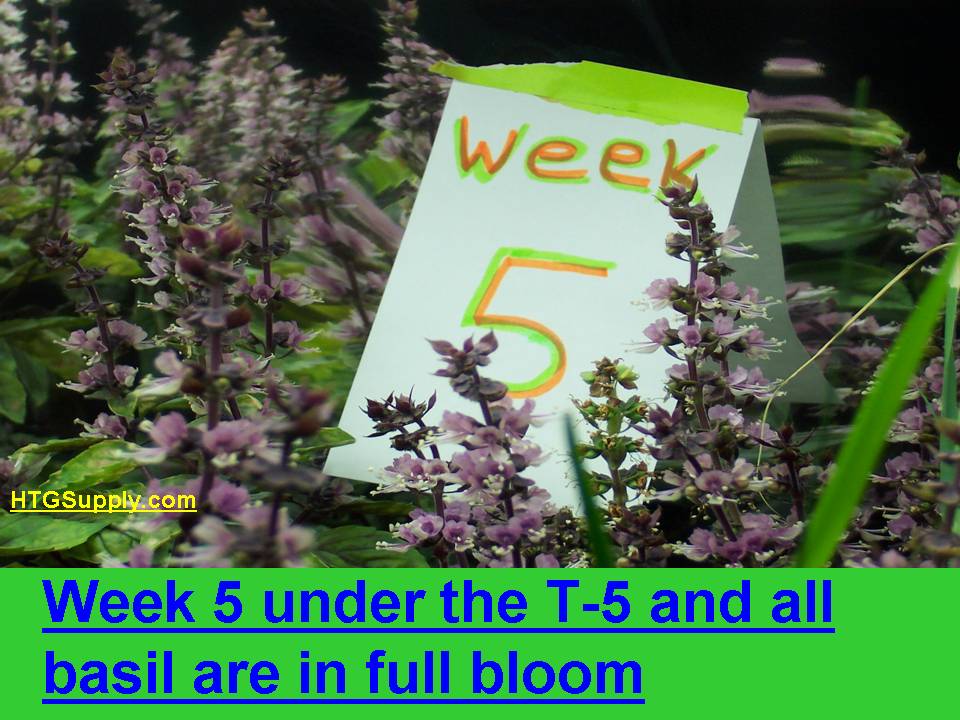
Five weeks after potting up and the basil plants have begun flowering under the LED and are in full bloom under the higher wattage and closer T-5. I set out to test (and show with a few pics.) if the Tri-Band from HTGSupply.com can grow plants. I have continued to use the grow tent and Tri-Band after eating the basil in these pictures. I have grown a couple different flower species, lots more basil, and marjoram. I can't say yet the LED is my primary light of choice, I am not getting rid of my 600 or 400 HPS. However, for growing in small spaces or indoors in general there are a lot of benefits to the LED. First, the Tri-Band LED has low heat production, it uses only 120 watts, yet has very high light intensity (you can germinate many seedlings under the light because you can keep it much higher above the seedlings than a fluorescent). Also, LED's do not loose light intensity like HID bulbs do (MH in 1 year and HPS in 2-3 years). LED's should put out the same intensity as day one for many years (100,000 hours are suggested but obviously I have not had time to test this yet). Moreover, the light wavelenghts of the Tri-Bband from HTGSupply.com can induce a good flowering response in basil and marjoram and I imagine all plants. Other LED may not promote proper flowering and/or vegetative growth even if they look red and blue to your eyes. All LED's are not the same.
I want to finish this series of posts about my first grow with 100% LED light by saying that the results I got with the Tri-Band beat the growth of any LED light I researched in scientific papers a few years ago. This technology is advancing all the time. I think that HTGsuply.com has got the edge on LED. However, I am open minded and I'd like to hear if other LED lights you have used have been duds or studs for your plant growth and if you have compared other LED's to the Tri-Band.
Again thanks for reading, I hope to help people grow for many more 100's of posts.
Good Growing,
Dr. E. R. Myers
If you are interested in growing herbs like me, I wrote about drying herbs in a previous post


5/12/10
The Best LED for Plant Growth IV (FLOWERING BEGINS)


The first thing you might notice is that I had to move some basil under the LED. They were getting big so I spread them out so the light could hit their lower leaves too. I added another tray (3 total under one LED, I could only get two full trays under the T-5)
Notice too how I have the T-5 on an angle with the taller plants one side and the shorter plants on the other. All the pictures of lights from HTGSupply.com will be nice and level , and lets face it, they look better that way. The truth is you may want to put lights at an angle to maximize the amount of light hitting each of your plants. The same idea can be solved from a different angle, some people raise individual plants up so that all plant tops are at the same level. Find what works for you.
The T5 is much closer to the plants and uses more electricity. This first test of the LED also proves a topic from previous posts on -- Speed up the Growth cycle -- Higher light intensity sped up the life cycle of the basil. Under the T 5 it began to flower a week before the LED did (oops spoiler for next post) This is NOT due to the type of light but the intensity. By lowering the LED or adding a single tube T5 to the grow tent to equalize the watts used then I think the LED would win.
I am also very happy with the seedling growth. The LED is almost one meter above the seedlings. You get the coolness of a fluorescent with the light intensity of an HID with this light.
Good Growing,
Dr. E.R. Myers
5/9/10
The Best LED for Plant Growth III
I am happy with the growth of the LED in week three. The T-5 as I knew it would had great growth as well but I don't have a good picture from week three of the T-5, but I do for the next few.
I have said that LED are a good light for growing in small spaces. I am more impressed as each week passes.
If you got the LED because of a problem with heat, you could also try adding some single lamp T5's in each corner of the tent to increase light with minimal heat. I believe that if you use LED with T5 in each corner you will get optimal results - but then we are talking about using almost 336 watts total. If you can handle the heat you might consider a 400w HPS.

The concept behind the Tri-Band 120 watt LED GROW LIGHT is simple – it uses highly efficient 1 watt LED’s, which are the exact wavelength required for photosynthesis. The 1 watt LED use wide angle directional bulbs for a wide area of coverage. The 1 watt LED is one of the most efficient light sources in the world (lumens per watt). By using only the spectrums required for plant growth, no energy is wasted generating spectrums of light that do little for a plants growth – such as green light. Also the directional LED’s ensure 100% of the light is pointed downwards – they do not rely upon reflective materials to direct the light. The High Power Tri-Band 120 watt LED GROW LIGHT can be used by itself for all cycles of plant growth (covers approximately 12-20 square feet).
Good Growing,
Dr. E. R. Myers
Subscribe to:
Posts (Atom)