6/6/10

PRECAUTIONS AND TIPS ON TRANSPLANTING YOUR PLANTS


When the roots of your plants have begun to outgrow their containers, it is time for your plants to be transplanted (Potted up). Potting up is necessary to allow your plant's roots to continue to grow, and is therefore a necessity for the overall health of your plants. When a plant becomes root bound (when the roots don’t have any medium to grow in) it can result in, slow growth and unhealthy plants, basically not good growing.
Transplanting can be a traumatic experience for your plants and there are precautions you should take to ensure success.
You should transplant when several roots start to stick out the bottom of your container. You should not do this too often but if you wait too long it can cause stunted or no growth, reduced yield, and increased disease susceptibility to name a few.
During potting up you should disturb the root system as little as possible. Even if you are very careful after transplanting you may have damaged the roots, so it will be hard for plants to take in water until new roots begin to grow. You should water your plants and keep the medium moist. It may also be a good idea to water your plants with a good water-soluble fertilizer that is intended for transplants. I have recommended fertilizers with Vitamin B1, like Hormex (always read and follow mixing instructions). After transplanting, your plants will need time to adjust and re-establish their root systems. They need low levels of nitrogen and potassium but will require large quantities of phosphorous. Also, studies have shown that a weak sugar and water solution made with plain sugar from the grocery store given to a plant after transplanting can reduce transplant shock in plants. It only helped with some plant species, but adding a teaspoon per gallon of sugar will not harm any plant, it is worth a try. The reasoning is that plants use sugars just like you and I. They usually make their sugars with photosynthesis but with limited water uptake from transplanting, giving your plants some extra ‘energy’ may help them keep growing or recover faster. If you give the plants sugar I suggest unrefined sugar if you can find it but try others there are many types of sugars, they all end in –OSE – sucrose, fructose, glucose, dextrose, maltose etc. are all sugars. (Now go read the back of your favorite cereal and see how much sugar it has.)

During the period after transplantation, your plant will have a reduced ability to absorb water and nutrients at first, and as a result they should have subdued light. I think fluorescents are best for this and that the HID is too intense. I think you could use an LED like the Tri-Band from HTGSupply.com if you kept it a few feet above the plants. (see my previous posts on growing with LED) I have begun to think that LED’s could be good for seedlings - with their low heat and high light output they can be placed high above the seedlings and cover a very large area compared to a fluorescent.

I have also read that people recommend you transplant late in the lights on cycle to give the plants all night to recover. You should also make sure the pot you are transplanting into is large enough for the roots of your transplants to grow and expand in. Growing indoors means you may have to grow in a small space  so you want to keep the plants in containers  that fit the space and the plant

You may come across articles that say while translating you should trim back the plant – I do not do this, I just can’t accept that cutting off leaves is good for a plant. Leaves are where the plants do photosynthesis so they provide energy to the plants. The logic with trimming is that if you remove the leaves this is less area for water loss and the plant won’t need as much water until the roots can grow. I would wager that trimming back the plants means you loose out on yields and over all growth later on, but I can’t back that up with an experiment yet. If you keep the roots in tact you should not have much of a problem. If you are transplanting a plant from say outdoors where you may not be able to get all the roots, THEN maybe I would recommend cutting back the plant so it does not die due to dehydration.

When the root systems are disturbed little, fertilizer is properly applied, and light is kept at a minimum for a few days your plants should show few signs of transplanting shock, or wilting.

Good Growing,
Dr. E.R. Myers


5/28/10

E-mail - white roots coming out of pot


Hey doc,

I have some plants growing and noticed the roots were starting to come out of the bottom drain holes of my pots. Some even have a white fuzz growing on them. Are my plants going to be able to grow ok, and how do I solve this problem?

Hello,
Your plants are getting big for the pots/ container they are in. If your plants are already well into flowering or making fruit you can just keep them in the same pots and make sure they are well watered (not over watered) until the plants are done. The idea is to keep the roots moist and alive and NOT dead  from being dry or in standing water.  Growing in small containers can be done but it requires more attention to detail, similar to hydroponics. I suggest you don’t transplant them if it is late in flowering because this may stress out the plants which causes poor flowering/fruit set. Next time you grow put the plants in bigger pots.  Unless you are confined to a small space  you should give your plants all the room to grow they need.

If your plants are growing vegetativly, you just need to pot them up (put them in the next size pot). I’ll be posting about potting up in the next week or so. If you just have one root coming through you can wait a few more days to pot up. If your plants look like the picture below, pot them up today.
The white fuzz is good; it is most likely root hairs.  Often on the end of roots you find a lot of small little hairs that stick out to give the roots more surface area so that they can absorb water and nutrients more efficiently. White roots are healthy and growing, even more so if they look fuzzy. If you don't put the plants in a new pot the roots will turn brown or tan. This is not necessarily bad but w/out any more space for roots to grow, you plants won't grow or flower at their best.

Good Growing,
Dr. E.R. Myers


5/22/10

E-mail HOW LONG DO MH AND HPS LAMPS LAST? and LED

HEY DOC,
HOW LONG DO MH AND HPS LAMPS LAST?

Hello, I have talked about this in a few posts but it would be good to have all the info. in one place, thanks for your question.
I assume you mean how long do the bulbs last; the ballast will last for many many years. I should say this is outside my area of expertise (which is growing plants) and you should send an E-mail to Sales@htgsupply.com. Perry the manager will be able to answer your question better than me. However I have used a lot of lights so I will give you my input too.

Most bulbs sold have a “rated life” that is stated on the carton or the literature. It is my understanding that rated life refers to the point at which 50% of the lamps in a large sample will be “burned out". This is not the end of the story, you should know there is a depreciation i.e. lower light output as bulbs age. Another factor to know is that the more you turn on and off your HID the shorter the rated life. You can tell a bulb is done when it starts to cycle on and off when the light should be ‘ON’.

I will assume you are using the HID for flowering and the light is on for only 12 hours a day. If you use the HID for vegetative growth and flowering your lights will have a shorter life then what I suggest.  I would use LED or fluorescent lights for seedlings and young plants and leave those lights on 24 hrs. a day to speed of the growth rate.  When you begin to flower you should know most HPS lamps have a rated life of at least 24,000 hours (over 5 years of flowering). Most MH lamps have a rated life of 10,000-20,000 hours. (2-4 years of flowering). HOWEVER, since all MH and HPS bulbs will slowly “depreciate” (decrease in light output) over time, good growers replace the bulb long before the light output declines significantly. I don't recommend using an HPS bulb more than 2-3 years and an MH more than one year.  I say this because your indoor garden yields are so closely tied to light output, and a 50% decrease in light output may result in a 50% decrease in yields. An HPS lamp will lose approximately 20% of its light output before it reaches its rated life while an MH lamp may lose up to 50% of its light output before it reaches its rated life. A MH will depreciate at a faster rate than an HPS. If your MH bulb is over two years old you may increase yield by 50% just by buying a new bulb. I always recommend keeping one old bulb (the one with the least hours) as a back up. I say this in case you have an accident and you break a bulb, your plants will need light with in 24 hrs, but some of you are 2-3 days from the nearest HTGSupply.com store or receiving a bulb by mail service.

You did not mention LED's but after my posts about growing with LED  I want to include them as a viable choice for growing indoors or in small spaces.  An LED like the Tri-Band has a rated life of 100,000 hours and has almost no depreciation. (That is 22 years flowering). If heat and / or electricity usage are a concern or you are thinking about growing for a long time, you should look at the Tri-Band LED from Htgsupply.com. You could use it in any grow set up but I used it in a grow tent with much success.

Good Growing,
Dr. E.R. Myers

5/17/10

The Best LED for Plant Growth V -- POST#100

If you have read all the posts on this blog from day one then you have read 100 posts so far.  Thank you!  If you just found this blog, you have a lot of back material you can search for information.  I find that writing something about growing each week (or more often) makes me a better grower.  Also, I enjoy reading and answering the E-mail's you send, it makes me learn new things or think about things that I sometimes take for granted everyone knows.  Please feel free to search this blog for answers to your questions and if you don't find specific answers write any time and I 'll help as best I can. 

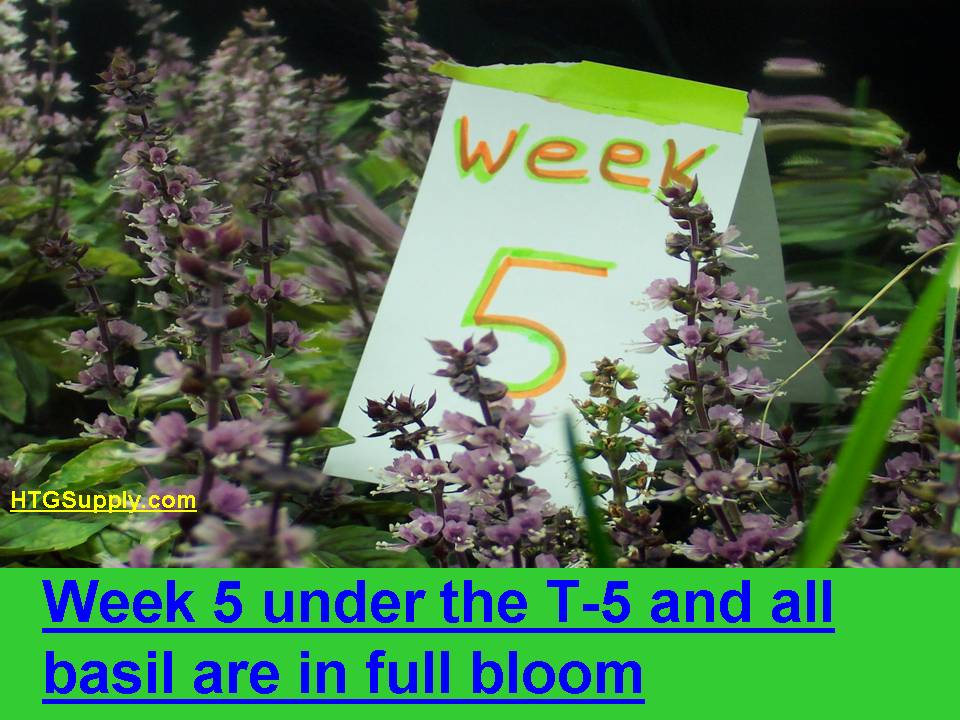
Five weeks after potting up and the basil plants have begun flowering under the LED and are in full bloom under the higher wattage and closer T-5.  I set out to test (and show with a few pics.) if the Tri-Band  from HTGSupply.com can grow plants.  I have continued to  use the grow tent  and Tri-Band  after eating the basil in these pictures.   I have grown a couple different flower species, lots more basil, and marjoram.   I can't say yet the LED is my primary light of choice, I am not getting rid of my 600 or 400 HPS.  However, for growing in small spaces  or indoors in general there are a lot of benefits to the LED.   First, the Tri-Band LED has low heat production, it uses only 120 watts, yet has very high light intensity (you can germinate many seedlings under the light because you can keep it much higher above the seedlings than a fluorescent).   Also, LED's do not loose light intensity like HID bulbs do (MH in 1 year and HPS in 2-3 years).  LED's should put out the same intensity as day one for many years (100,000 hours are suggested but obviously I have not had time to test this yet).   Moreover, the light wavelenghts of the Tri-Bband from HTGSupply.com can induce a good flowering response in basil and marjoram and I imagine all plants.  Other LED may not promote proper flowering and/or vegetative growth even if they look red and blue to your eyes.  All LED's are not the same.
 I want to finish this series of posts about my first grow with 100% LED light by saying that the results I got with the Tri-Band beat the growth of any LED light I researched in scientific papers a few years ago.  This technology is advancing all the time.  I think that HTGsuply.com has got the edge on LED.  However, I am open minded and I'd like to hear if other LED lights you have used have been duds or studs for your plant growth and if you have compared other LED's to the Tri-Band.
Again thanks for reading, I hope to help people grow for many more 100's of posts.

 Good Growing,
 Dr. E. R. Myers

If you are interested in growing herbs like me, I wrote about drying herbs  in a previous post